
How to Make Mens Wedding Ring Tighter
A ring that spins every time you wash your hands or slips sideways in cold weather can go from mildly annoying to genuinely stressful fast. If you are wondering how to make mens wedding ring tighter, the right fix depends on the ring’s material, how loose it feels, and whether you need a short-term solution or a permanent one.
That matters even more with modern men’s bands. A classic gold ring gives a jeweler more resizing options than tungsten, ceramic, meteorite, Damascus steel, or an inlay band with wood, opal, or crushed stone. Some rings can be resized traditionally. Others cannot, at least not without risking the structure or design. So the goal is not just making the ring tighter. It is making it tighter without damaging a piece that may carry real meaning.
How to make mens wedding ring tighter without damaging it
The safest place to start is by figuring out how loose the ring actually is. If it spins but does not feel close to falling off, a temporary adjustment may be enough. If it slides over the knuckle with almost no resistance, you are probably looking at a more permanent sizing solution.
Temperature can also trick you. Fingers shrink in cold air and swell in heat, after workouts, or after salty meals. If the ring only feels loose at certain times of day, you may not need a full resize at all. Check the fit in the afternoon and evening when your hands are at a more average size. A properly fitted wedding band should slide on with some ease and come off with a little resistance at the knuckle, not drop off when your hand is relaxed.
If your ring suddenly feels much looser than it used to, weight loss is often the reason. That is common and nothing to worry about, but it does mean the fit issue is unlikely to fix itself.
Temporary ring adjusters
For a quick, low-risk fix, a ring adjuster is usually the best first move. These are small inserts or flexible guards that sit inside the band and reduce the interior space. They are popular because they do not permanently alter the ring, and they are especially useful if you are between sizes or waiting to confirm the fit before making a bigger decision.
Silicone adjusters are the most common. They are soft, inexpensive, and easy to remove. Some wrap around the bottom of the band, while others clip into the inside. They can work well for men’s wedding bands because they add enough grip to stop spinning without changing the appearance much from the top.
The trade-off is comfort and longevity. Some people barely notice them. Others find them irritating, especially on wider bands or during all-day wear. They can also trap moisture and soap residue if not cleaned regularly. If you choose this route, take the ring off often enough to clean both the ring and the adjuster.
Sizing beads and inner sleeves
If your ring is made from a resizable metal, a jeweler may recommend sizing beads or an inner sleeve. Sizing beads are small metal bumps added inside the band. They help the ring fit more snugly while still allowing it to pass over the knuckle. This can be a smart option for someone whose knuckle is larger than the base of the finger.
An inner sleeve or spring insert is a bit more specialized. It can create a tighter fit while preserving the outer shape of the ring. This tends to be more of a jeweler-level solution than a DIY one, but it is worth knowing about if your ring is valuable or sentimental and traditional resizing is not ideal.
Can every men’s wedding band be resized?
No, and this is where material really matters.
Gold, platinum, and silver bands are usually the easiest to resize. A jeweler can often remove a small section or add metal, then refinish the piece. Stainless steel is more difficult. Tungsten carbide, ceramic, titanium, cobalt, and many alternative metal rings are often not resizable in the traditional sense.
That does not mean you are out of options. It just changes the best option.
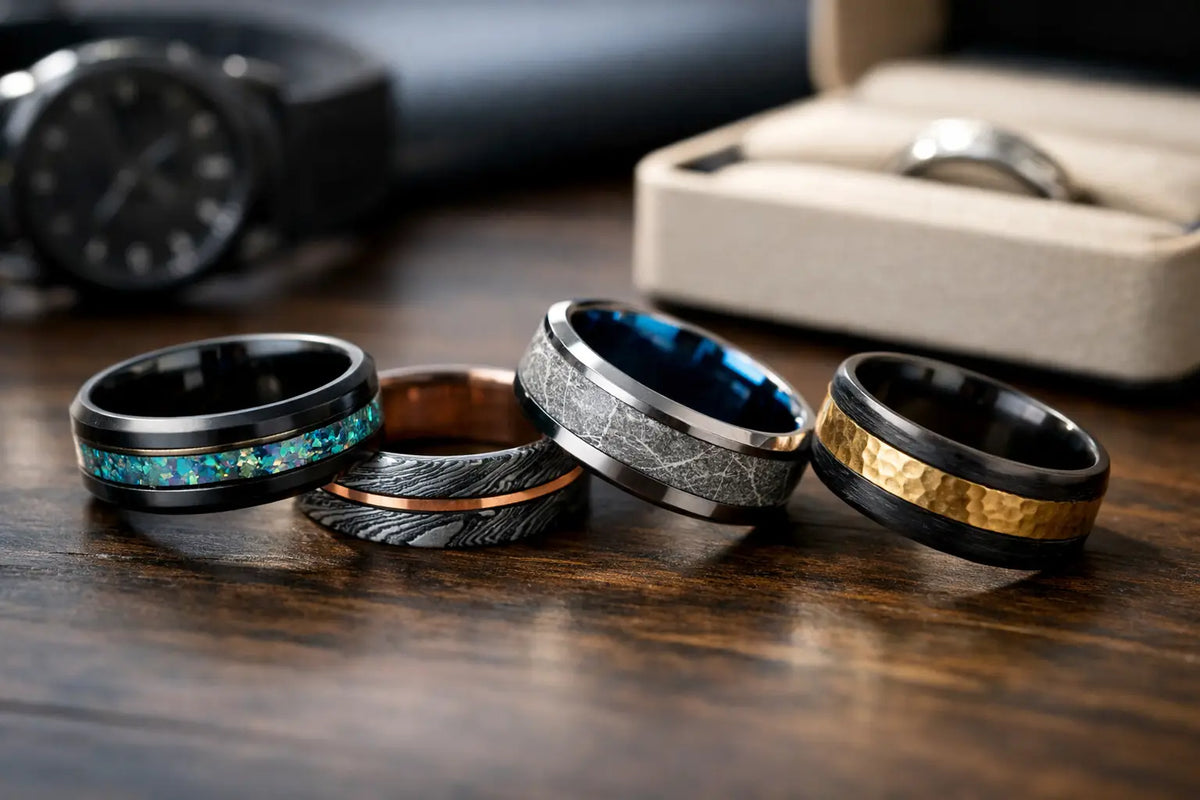
Tungsten and ceramic are loved for a reason. They are durable, scratch resistant, and hold a crisp look beautifully. But that hardness is also why standard resizing usually is not possible. A ring made with meteorite, opal, dinosaur bone, antler, wood, glow powder, or other intricate inlays can also be difficult to alter safely, even if part of the structure is metal. Handmade statement bands often combine materials that look incredible together but do not behave like plain gold when heat, cutting, or stretching are involved.
For rings like these, the safest answer is often replacement in the correct size rather than forced alteration. That may sound frustrating, but it protects the design, the inlay, and the comfort of the ring long term.
When a jeweler can help and when DIY is enough
If you only need the ring slightly tighter, DIY solutions can absolutely be reasonable. A removable adjuster is practical, affordable, and useful if your finger size changes with the seasons. It is also a good stopgap if you bought the ring online and are still deciding whether to exchange it.
If the ring is noticeably loose, avoid home fixes that involve glue, tape, or anything marketed as a permanent coating for the inside of the band. Those shortcuts can create skin irritation, wear unevenly, and make professional help harder later. They also tend to look sloppy fast.
A jeweler is the better choice when the ring is expensive, deeply sentimental, or made from a material combination you do not fully understand. Even if the ring cannot be resized, a jeweler can tell you whether an insert, beads, or another non-destructive option is realistic.
For handcrafted alternative-material rings, it is often even better to ask the original maker first. They know the construction, the inlay depth, and whether the band was designed to allow any adjustment. Brands that specialize in distinctive wedding bands usually deal with sizing questions all the time, which makes their guidance more useful than a generic guess.
How to know if you need a resize or a replacement
A good rule is to think in terms of how many sizes off the ring feels. If it is only a little loose, an adjuster may handle it comfortably. If it feels a full size or more too large, a permanent solution usually makes more sense.
You should also look at the ring style. A plain comfort-fit band gives more room for adjustment strategies than a ring with channel details, faceted edges, or delicate inlays. Wider bands can also feel tighter than narrow ones, so sizing is never just about the number stamped on a ring tool.
If the ring has rare materials or bold design work, protecting the look should be part of the decision. A men’s wedding band is not just a metal loop anymore. It might feature meteorite that tells a cosmic story, dinosaur bone with natural patterning, or opal that flashes different colors in the light. Those details are exactly why many couples choose a nontraditional ring in the first place. A fix that compromises them is usually not worth it.
That is why many shoppers prefer a brand that treats sizing as part of the buying experience, not an afterthought. With handcrafted rings, clear sizing guidance and responsive support can save a lot of frustration later.
The smartest fix starts with the ring itself
If you are trying to figure out how to make mens wedding ring tighter, start with the least invasive option that matches the ring’s material and the amount of looseness. For a minor fit issue, a high-quality silicone adjuster can be a simple answer. For traditional precious metals, a jeweler may be able to resize the band cleanly. For tungsten, ceramic, or inlay-heavy designs, an exchange or replacement is often the safest route.
There is no prize for forcing a ring into the wrong kind of repair. The better move is preserving both the fit and the craftsmanship, especially when the band was chosen for its story as much as its style.
A wedding ring should feel secure, comfortable, and easy to wear every day. If it does not right now, that is fixable - and the best fix is the one that respects what makes your ring worth wearing in the first place.